
Home Improvement Leads: How to Get Them and Which Ones Pay

The best home improvement leads come from a mix of sources you own (local search, reviews, referrals, past customers) and a few paid channels, all tracked to booked jobs instead of to cost per lead. A $40 lead that never answers the phone is more expensive than a $120 lead that books. Most contractors who say they need more leads are already losing a share of the ones they pay for. We build lead generation funnels for trade contractors, and the pattern is the same across roofing, remodeling, painting and landscaping: the contractors with steady schedules treat lead generation as a connected system, not a single ad account.
This guide is for contractors and owners of home improvement companies. It covers what a lead is worth, what each channel costs, how to rank your local presence, and how to follow up and measure so that every dollar traces back to a signed job.
TL;DR
Cost per lead is the wrong scoreboard. Judge every source by cost per booked job and cost per signed contract.
The average home improvement search-ad lead cost $90.92 in a LocaliQ analysis of search campaigns, and cost varies widely by trade and market.
Referrals and repeat customers are the top source for most owners, and local search and reviews are how those referrals verify you before they call.
Speed and consistency of follow-up decide how many leads become appointments. Fix that before buying more leads.
Our Growth and Essential plans combine local SEO, PPC, CRM automation, reviews and real-time reporting in one system.
Table of Contents
What a home improvement lead actually is
A home improvement lead is a homeowner who has raised a hand for a project: a form fill, a phone call, a text, a booked estimate. That alone does not make it a good lead. A qualified lead is one where four things line up:
Decision-maker: the person owns the property or can approve the work, not a tenant or someone gathering ideas for a spouse.
Budget: the homeowner has a realistic idea of what the work costs.
Fit: the project is something you actually do, in an area you actually serve.
Timing: they want to start in a specific, realistic window, not “sometime.”
These filters matter because every lead source sends a mix. Shared leads sold to several contractors at once tend to arrive with all four unknown. Leads from your own website, your Google Business Profile or a past customer usually arrive with some of them already answered. When you compare channels, compare how many of their leads pass these four checks, not only how many arrive.
What home improvement leads cost
The published benchmarks give you a range, not a promise. LocaliQ’s analysis of more than 3,200 search ad campaigns between April 2024 and March 2025, reported by The DailyMoss, put the home improvement average at $90.92 per lead. Google Ads alone averaged $70.11 per lead at a $7.85 cost per click, with click-to-lead conversion typically around 5 to 6 percent.
That average hides large gaps. A pool and spa lead and a roofing lead are different animals, because a roof replacement carries a much larger ticket. The same report series shows trade-level search costs that start in the mid-$40s and climb above $200 for the most expensive categories. Your market matters too: a click in a dense metro costs far more than the same click in a mid-size town.
Two habits keep the numbers honest:
Compare channels on the same basis. Cost per lead, cost per booked appointment and cost per signed job are three different numbers. Only the last pays your bills.
Read paid-search numbers by campaign type. Branded searches (people typing your company name) are cheap and mostly capture demand you already earned. Non-branded searches (“kitchen remodel near me”) are where you buy new customers, and they cost several times more.
Where homeowners actually find contractors
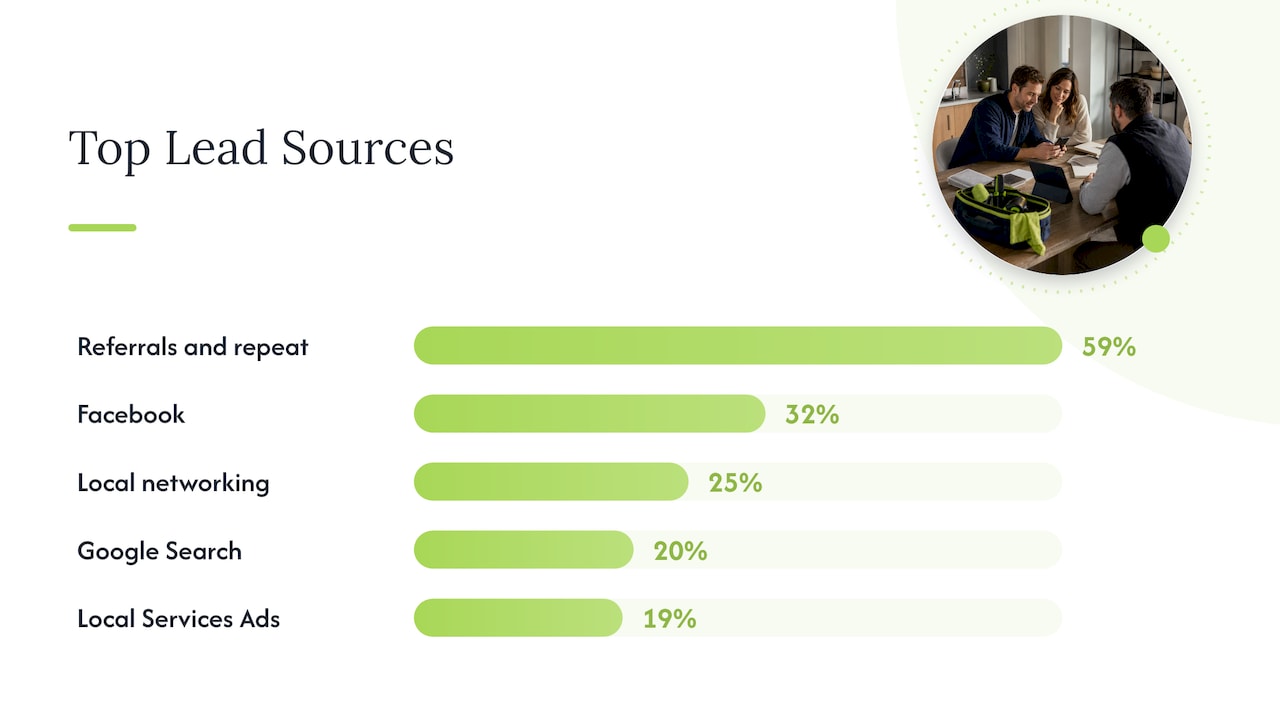
Before spending, look at where work comes from for other owners. Jobber’s survey of 1,050 home service business owners, fielded in December 2025 and summarized by Tom Riley, found that 59% named referrals and repeat customers as top lead sources. Facebook followed at 32%, local networking and partnerships at 25%, Google Search at 20%, Local Services Ads at 19% and lead-selling sites at 16%.
Homeowners say much the same thing. In a 2025 survey of 1,000 US homeowners cited by Acorn Finance, 69% hired an HVAC contractor they had used before or one recommended by friends and family, far more than found one through search or ads.
Do not read that as “skip online marketing.” The same write-up cautions that owners over-credit referrals because referrals are the only source they see clearly, and notes that 75% of US consumers use more than one channel before deciding. A neighbor recommends you, then the homeowner searches your name, reads your reviews and looks at your website. Referral is usually the last step of a search journey, and search is the verification step of a referral. If your online presence is thin, you lose referrals you already earned.
The channels that work, and how to use each
Local search and your Google Business Profile
For a contractor, the map results at the top of a local search are the most valuable real estate online. Whitespark’s local ranking factors survey, cited by OnwardCraft, attributes 32% of local pack ranking weight to Google Business Profile signals and 20% to review signals, and reports that complete profiles get 7 times more clicks than incomplete ones.
Practical steps:
Pick the right primary category (for example, roofing contractor or kitchen remodeler) and add every service you perform.
List the cities and neighborhoods you serve, and keep your name, address and phone number identical everywhere online.
Upload real project photos on a steady schedule, not all at once.
Build service pages on your website for each trade and each major city, with project photos, price context and a clear call button.
Local search compounds slowly. A new profile typically needs months before it shows up consistently in the map results, and the most common failure is quitting at month two. Local SEO and website work are part of what we do for trade contractors, and you can see how the pieces fit in our guide to local leads and local SEO for contractors.
Reviews
Reviews do double duty: they raise your local ranking and they decide who gets the call. BrightLocal’s 2025 consumer survey, as relayed in one 2026 contractor sources ranking, found 97% of consumers read reviews before choosing a local business, and 31% will only use a business rated 4.5 stars or higher.
Make asking a fixed step in your job close-out: a text with a direct review link within a day of finishing, while the homeowner is still pleased with the work. Reply to every review, including the occasional bad one, in a calm and specific way. Review requests and replies are easy to forget on a busy week, which is why we automate them inside the CRM.
Paid search and Local Services Ads
Paid search is the fastest way to appear in front of a homeowner who is ready to hire today. Google’s Local Services Ads sit above standard ads and charge per lead rather than per click, so you pay when a homeowner contacts you through the ad. Standard search ads charge per click, and cost per lead depends on your landing page and your phone handling as much as on the bid.
What separates profitable campaigns from expensive ones:
Segment by service. One campaign for roof replacement and another for repair, one for bathrooms and another for kitchens. Messages match intent, and wasted clicks drop.
Use a dedicated landing page for each campaign, with one offer and one action. Sending paid clicks to a home page is the most common leak.
Exclude what you do not sell. Negative keywords such as “jobs,” “DIY” and “free” keep students and job seekers out of your budget.
Answer the phone. A missed call on a paid click is pure wasted spend.
PipelineOn’s 2026 benchmarks, drawn from a study of 816 contractors, report that 37.6% of non-branded Google Ads leads resulted in a booked appointment. That means more than six in ten paid leads never book. The gap is the opportunity.
Referrals, past customers and local presence
These channels cost the least per lead and close at the highest rates, so they deserve a system, not hope. A Pro Remodeler report on large home improvement companies described a past-customer campaign: mailers sent twice a year followed by phone calls, with fully loaded lead costs near 2%.
A simple version for a smaller company:
Export every customer from the last five years into your CRM.
Send a seasonal check-in (gutters in fall, exterior paint in spring) twice a year.
Offer a referral thank-you after a completed job, and ask at the moment of peak satisfaction.
Attend home shows and community events and capture every contact in your own CRM. Qualified Remodeler’s 2025 lead-gen report found that self-generated leads are owned by the company in its CRM, which is the reason readers ranked this approach so highly.
Social media
Facebook ranked second in the Jobber survey above. It works best as proof of work: finished-project photos, before-and-after sets, short crew introductions, and answers in local community groups. Treat it as a way to be remembered and recommended rather than a place to buy cold leads, and always link posts to a page where a homeowner can book.
Lead-selling marketplaces
Marketplaces sell leads that go to you and to several competitors. They can fill a gap in a slow month, but you are racing other bidders, the homeowner has often already called three companies, and you do not own the relationship afterward. Only 16% of owners in the Jobber survey named them as a top source. Use them to supplement, never as the foundation.
A quick comparison
Source | Speed to results | Typical lead quality | Who owns the lead |
Referrals and repeat customers | Slow to build, steady | Highest close rates | You |
Google Business Profile and local SEO | Months to compound | High intent, grows over time | You |
Local Services Ads | Days to weeks | High intent, pay per lead | You |
Non-branded paid search | Days | High intent, highest cost | You |
Facebook and local groups | Weeks | Warm, trust-based | You |
Lead marketplaces | Immediate | Mixed, shared with rivals | Shared |
Top-performing owners in the Jobber data consistently use three to five sources. The goal is not to find the one perfect channel, but to build a small portfolio where each source supports the others.
Follow-up is where most leads are lost
The cheapest lead you will ever get is one you already paid for. Industry interviews keep making the same point: when a company says it needs more leads, it is usually not doing enough with the ones it has. An ActiveProspect interview with a home improvement consultant gives healthy funnel benchmarks for the category: a set rate of 28 to 32 percent across the marketing mix and a net close rate of 25 to 35 percent.
If your numbers sit well below that, fix these before raising your ad budget:
Respond in minutes. Track the time from a new request to the first human response, and compare booked rates by response time. Check after-hours requests separately, because many homeowners submit forms at night.
Automate the first touch. An instant text and email confirming the request, with a booking link, keeps the lead warm while your crew is on a roof.
Run a follow-up sequence on every unsold estimate. Estimates stall because nobody followed up, not because the homeowner said no. Three to five touches over a few weeks is a reasonable minimum.
Log everything in one CRM, so you can see which source produced each appointment and each sale.
If your CRM, forms and automations are scattered across tools, a revenue operations specialist can connect lead response and estimate follow-up into one workflow. For the pipeline stages and metrics themselves, see our guide to the contractor sales pipeline.
Measure by booked jobs, not by leads
Take two channels. One delivers a $40 lead that books 20% of the time, and the other delivers a $120 lead that books 60% of the time. Both cost $200 per booked job. If you only watch cost per lead, you will keep funding the first and starve the second, and your phone will be busy with people who never become customers.
Build a simple scorecard by source, updated monthly:
Metric | How to calculate |
Cost per lead | Spend divided by leads |
Booking rate | Booked appointments divided by leads |
Cost per booked job | Spend divided by booked appointments |
Close rate | Signed jobs divided by estimates |
Cost per signed job | Spend divided by signed jobs |
Revenue per dollar spent | Signed revenue divided by spend |
Scale the sources where the later numbers are strong and fix or pause the ones where leads arrive but nothing books. A source that sets appointments well and closes well deserves more budget. A source that sets few appointments should be diagnosed first: is it a lead quality problem or a follow-up problem? The way to find out is to track the same source through every stage, which is why measuring the full funnel matters more than any one platform’s dashboard.
One caution on referrals: they are hard to attribute because the homeowner often searches you before calling. Ask every new customer “how did you hear about us?” and record the answer in the CRM, then compare it with the call tracking and form data.
How to get more home improvement leads: a 90-day plan
Days 1 to 30: fix the foundation. Complete your Google Business Profile. Audit your website for a clear phone number, a booking form that works on a phone, and a page per core service. Start a review request routine. Set up call tracking and a CRM so every lead has a source.
Days 31 to 60: add paid demand. Launch a small, segmented search campaign and Local Services Ads for your most profitable service. Send each to its own landing page. Add an instant text response and an estimate follow-up sequence.
Days 61 to 90: read the scorecard. Compare each source on booking rate, close rate and cost per signed job. Move money from the weakest to the strongest, and start the past-customer campaign for the season ahead.
If you are in a specific trade, our trade guides go deeper: roofing lead generation, remodeling leads and HVAC contractor leads.
Our perspective
Most contractors come to us asking for more leads. In our experience building lead generation funnels for trade contractors, the real problem is usually unpredictable revenue: a great month followed by a quiet one, with no clear reason for either. That is why we do not treat SEO, ads, reviews and follow-up as separate jobs. Our approach puts local SEO, PPC, landing pages, CRM automation, reputation management and real-time reporting into one feedback loop. The reporting shows which source produced which booked job, and the results feed back into the campaigns so budget moves toward what works. The contractor’s job is to run crews and deliver quality work. We believe marketing should take as little of their time as possible and still be measurable at every step. When a funnel is built this way, lead quality and consistency improve together, and revenue becomes something you can plan around. A1 Contractor Marketing
What it looks like to have this done for you
Running local SEO, paid campaigns, a CRM and review requests alongside a full schedule is a lot to carry. We build and manage the whole funnel for trade contractors, from local search and PPC to landing pages, CRM integration, review management and real-time reporting. Our published plans are Growth at $2,450 per month and Essential at $3,500 per month, and there is also a Full Service plan where marketing is completely outsourced. You can compare them on our pricing page.

If you work in a particular trade, see how we approach lead generation for contractors and trades, marketing for roofers or marketing for painters. To weigh your options, read how to choose a contractor marketing agency.
FAQ
How do I get more home improvement leads?
Start with the sources you own: a complete Google Business Profile, service pages for each trade and city, a steady flow of reviews, and a system for asking past customers for work and referrals. Then add paid channels such as Local Services Ads and segmented search campaigns, and connect everything to a CRM so you can see which source books jobs.
What is a good cost per lead for home improvement?
The LocaliQ search benchmark put the home improvement average at $90.92 per lead, but trade and market change that figure a lot. A better test is cost per booked job and cost per signed job. A higher-cost lead that books and closes more often can be the cheaper way to win work.
Are shared leads from marketplaces worth it?
They can supply volume quickly, but the same homeowner is usually contacting several companies, so speed and price decide who wins. You also do not own the contact afterward. Contractors who build exclusive sources, such as local search, referrals and their own ads, tend to control costs and close rates better.
How fast should I respond to a new lead?
As fast as you can, ideally within minutes, and with an automated text or email as the first reply if you are on a job site. Track response time against booking rate in your CRM and review after-hours requests separately. Quick replies keep the homeowner from moving on to the next company.
How long does local SEO take to bring in leads?
New profiles typically take several months to gain traction in the map results, and gains build on one another as reviews and content accumulate. Pair it with paid search for immediate demand while the organic side grows.
Sources
Average Home Improvement Contractor Cost Per Lead in 2025, The DailyMoss
Trades & Construction Lead Generation Statistics 2026, Tom Riley
Local SEO Statistics Every Contractor Should Know, OnwardCraft
2026 Home Service Marketing Benchmarks and Insights, PipelineOn
Home Improvement Powerhouses Weigh In on Lead Gen, Pro Remodeler
Recommended
Comments