
Construction Marketing Agency: How to Choose One That Delivers Leads


A construction marketing agency earns its fee when your phone rings with the right jobs, month after month. The best fit for a trade contractor is an agency that runs local SEO, paid ads, landing pages, CRM follow-up and reviews as one connected system, and shows you the numbers weekly. That is how we build it at A1 Contractor Marketing, and this guide shows how to judge any agency against that standard.
TL;DR
A construction marketing agency should fill your pipeline with qualified local leads. Brand awareness and impressions are not the goal.
The services that matter most for trades are local SEO, pay-per-click (PPC) ads, conversion-focused landing pages, CRM automation and review management.
Agencies come in several types. Pick one built around the trade you work in and the kind of work you sell.
Judge results by cost per lead, booked estimates and closed revenue, and give campaigns months, not weeks.
Our published plans are GROWTH at $2,450 per month and ESSENTIAL at $3,500 per month. FULL SERVICE (completely outsourced) has no published price.
Table of Contents
What a construction marketing agency actually does
An agency takes over the work of getting your company found, contacted and chosen by people who need a project done. For a roofer, painter or landscaper, that mostly means winning local search results, running ads that bring in calls, and making sure every inquiry gets answered fast.
The core services:
Local SEO. Getting your company to appear when someone searches for your trade in your service area. Construction is local by nature, so this is usually the base of everything else.
PPC advertising. Paid ads that put you in front of buyers right now, while organic rankings build.
Landing pages and funnels. Pages built around one offer and one action, so a visitor becomes a call or a form fill.
CRM integration and automation. A system that logs every lead, follows up automatically and shows which source it came from.
Review and reputation management. A steady flow of customer reviews, because buyers compare contractors before they call.
Reporting. Live numbers on leads, cost and results, used to adjust campaigns.
These pieces work best together. Ads send traffic to a landing page, the page captures the lead, the CRM follows up, and the reviews help the next prospect say yes. When each piece comes from a different vendor, nobody owns the result and the data rarely lines up. Our own approach is to run SEO, PPC, automation, CRM and real-time reporting as a single system, built specifically for trade contractors, so the results feed back into the campaigns. You can see how we frame this for general contractors on our marketing for construction companies page.
The types of agencies you will run into
Searching for an agency turns up very different businesses under the same label. The Construction Marketing Association’s agency selection guide describes eleven types of agencies and a four-step selection process, which tells you how wide the field is. For a trade contractor, it helps to sort them into a few practical groups:
Type | Typical focus | Fit for a trade contractor |
Lead generation specialist for trades | Local SEO, PPC, funnels, CRM, reviews | Strongest fit when you want booked estimates |
Full-service marketing and branding firm | Brand, web design, print, PR, social | Better for large commercial builders with long sales cycles |
Website and design studio | Site builds and redesigns | Useful only if the site is the single problem |
Single-channel shop | Only SEO, only ads or only social | Works if you already have the other channels covered |
Lead marketplace or pay-per-lead network | Sells shared leads | Leads can be shared with competing bidders |
If you are a roofer, landscaper, painter or other residential and light-commercial trade, the first row is where your questions should start. If you sell to developers, architects and public owners, brand and relationship marketing carries more weight. Anyone can check how a site presents itself before reaching out. A website trust score checker is one way to review an agency’s own web presence for ownership, reputation and security signals before you book a call.
How agencies adapt to roofers, landscapers and painters
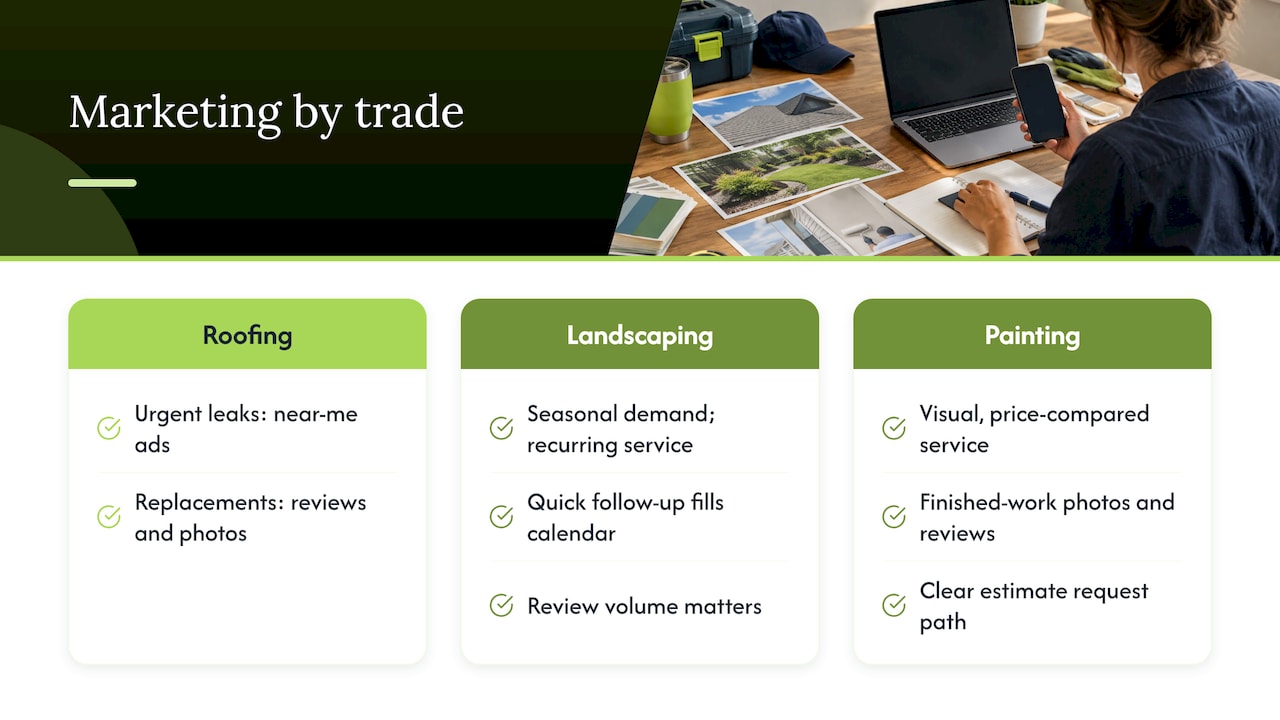
The channels are the same, but the buying behavior is not, and a good agency tunes the plan to the trade.
Roofing. Many roofing jobs start with an urgent problem, such as a leak or storm damage, so ads and map listings that capture “near me” searches matter. Larger replacements involve more comparison shopping, so reviews and photos of finished work carry weight. See how we approach it on our marketing for roofers page, or read our guide to choosing a roofing marketing agency.
Landscaping. Demand follows the seasons, and many customers want recurring service. That makes consistent lead flow, quick follow-up and review volume important for filling the calendar. Our marketing for landscapers page covers it.
Painting. Painting is a visual, price-compared service. Photos of finished interiors and exteriors, strong reviews and a clear estimate request path do most of the work. See marketing for painters.
In every case, the question to ask an agency is the same: how will you target the specific jobs I want, in the specific towns I serve?
What construction marketing costs
Price depends on scope, the number of service areas, how competitive your market is and how much of the work you hand off. Ad spend, the money paid to the ad platforms themselves, is a separate budget from the agency’s fee. Ask any agency to state clearly which is which.
Our published plans, as listed on our pricing page:
Plan | Price |
GROWTH | $2,450 per month |
ESSENTIAL | $3,500 per month |
FULL SERVICE (completely outsourced) | No published price |
The FULL SERVICE option is for contractors who want marketing handled completely for them, so the owner can stay on the job site. Because there is no published price, the pricing page and a consultation call are where to get it.
When comparing quotes, line up what each one includes: SEO, ads, landing pages, CRM setup, review management and reporting. A low monthly fee that covers only one of these can cost more in the end if you have to buy the rest elsewhere. For a deeper look at how the numbers break down, read what contractor lead generation works and what it costs.
How long results take
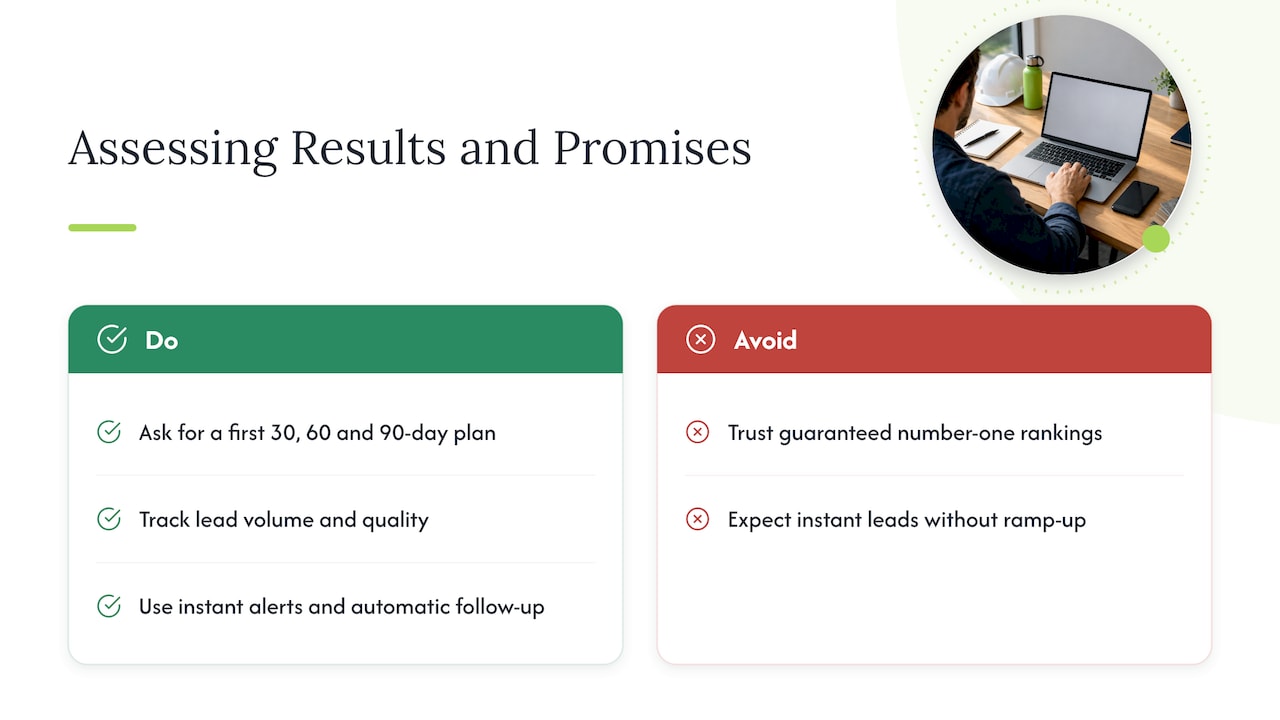
Paid ads can produce calls within days of launch, though they are tuned over the first weeks as the data comes in. Local SEO builds more gradually, since search rankings and map visibility improve as your site, listings and reviews strengthen. Plan on a ramp-up period, and judge the first months by direction: are lead volume and lead quality improving?
Beware of two promises. One is guaranteed number-one rankings. The other is an instant flood of leads with no ramp-up. Neither describes how local marketing works. A credible agency explains what it will do in the first 30, 60 and 90 days and what you should see at each point.
It also pays to look at what happens after the lead arrives. A lead that waits a day for a callback is often lost to a competitor. Tools that alert you instantly and follow up automatically are part of the result. A free lead revenue calculator helps you put a dollar figure on what missed or slow-answered leads cost your business each month.
How to tell if the marketing is working
Impressions and website traffic feel like progress, but they do not pay the crew. Track the chain from first contact to revenue:
Leads by source. Calls, forms and messages, each tagged to SEO, ads, map listings or referrals.
Cost per lead. Marketing spend divided by leads, by channel.
Booked estimates. How many leads became a scheduled visit.
Closed jobs and revenue. The number that settles the argument.
Return on investment (ROI). Revenue from marketing-sourced jobs compared with total spend.
This is why CRM integration matters. Without it, an agency can only report leads, and you are left guessing which ones turned into jobs. With it, the agency and you read the same report. For a practical walkthrough of measuring return across channels, see this guide to tracking advertising ROI.
Make sure the numbers come to you in real time, not once a quarter in a slide deck. Real-time reporting lets campaigns be corrected while there is still budget to save.
How to choose a construction marketing agency
Put these questions to every agency you consider:
Do they work with trade contractors every day? Experience with roofers, painters, landscapers and builders means they already understand your seasons, your job sizes and your buyers.
Which services are included? Look for local SEO, PPC, landing pages, CRM and reviews working as one system.
Who owns the accounts? Your ad accounts, analytics, listings and website should be in your name.
How is reporting delivered? You want leads, cost per lead and booked jobs, shown regularly and clearly.
How much of your time does it take? The goal is a marketing engine that needs little of your attention.
What does the contract look like? Understand the term, what is covered and how changes are handled.
Our longer guide, how to choose a contractor marketing agency, goes through each of these in more detail.
Our perspective
Contractors rarely struggle because they do bad work. They struggle because revenue arrives in waves: a full calendar one month, silence the next. Marketing built from separate pieces tends to reproduce that pattern, because nobody is accountable for the whole path from search to signed job. We built A1 Contractor Marketing around that problem. Local SEO, targeted ads, landing pages, CRM automation and review management work as a single feedback loop, and real-time performance measurement lets us see which part of the loop to adjust. The aim is predictable lead flow and better lead quality, with minimal time spent on marketing on your side. Our approach is data-driven. If a channel produces calls that never turn into estimates, the numbers show it and the campaign changes. That discipline is what turns marketing from an expense you hope will work into a system you can plan around. A1 Contractor Marketing
Where A1 Contractor Marketing fits
We are a lead generation agency for trade contractors. Our service covers local SEO, PPC campaigns, landing page and funnel optimization, CRM integration and automation, review management, and real-time reporting with campaign optimization. Plans start with GROWTH at $2,450 per month, with ESSENTIAL at $3,500 per month and a completely outsourced FULL SERVICE option.

If you want to see what a connected lead system looks like for your trade and service area, start with our contractor lead generation page, compare the plans on our pricing page, or book a consultation call from there.
FAQ
What is the difference between a construction marketing agency and a general marketing agency?
A construction marketing agency knows how trade buyers search, compare and decide, and builds campaigns around local service areas and job types. A general agency often spreads effort across brand, social and content with less focus on booked estimates. For trade contractors, the specialist’s focus on lead flow usually matters more.
Should a small contractor hire an agency or run marketing in-house?
Most owners are busy on job sites and do not have time to run SEO, ads, follow-up and reviews at the same time. An agency takes that work on and ties it together with reporting. A fully outsourced plan like our FULL SERVICE option is designed for owners who want to stay focused on the work itself.
What should a construction marketing agency report on?
Ask for leads by source, cost per lead, booked estimates, closed jobs and return on investment. These tie marketing spend to revenue. Impressions and clicks are supporting data, not proof of results.
Do I need SEO and ads at the same time?
They do different jobs. Ads bring in calls quickly, while local SEO builds lasting visibility in search results and maps. Running both, with landing pages and a CRM behind them, gives you immediate leads and a growing base of organic ones.
Sources
Recommended
Comments